Warner School & URochester experts challenge common assumptions about academic success—and offer practical ways to become a more successful college student.
(Initially published September 4, 2026, on the University of Rochester’s News Center)
Everyone thinks they know what a good student looks like: someone who sits near the front, raises a hand, turns in assignments on time, and earns good grades. But some of the qualities we associate with being a good student may have less to do with learning than with appearing to be learning.
That distinction is at the heart of research by Claire Boeck, an assistant professor at the University of Rochester’s Warner School of Education & Human Development. She studies how students and instructors define and sometimes disagree over what it means to be a “good student.”
“Being a good student is a work in progress.”
“I think most people define a good student in terms of being responsible and hardworking, following instructions,” Boeck says. And when Boeck surveys and interviews instructors and students separately, both groups name many of the same qualities. But important differences emerge around the concept of effort.
Students know the late nights, repeated problem sets, rearranged work shifts, and private persistence that go into their work. But those who evaluate them often cannot see all of that. “Instructors tend to define effort in terms of what they can see,” Boeck says: who visits office hours, who raises a hand, and who submits assignments on time.
As a high school student, Boeck worked the late shift at her local IHOP restaurant, completing homework between orders and sometimes sleeping through morning classes. “Most people would have said I was not a good student, but I was still getting good grades,” she says. “My effort was not visible in class.”
The problem, she says, is the ambiguity of the word good. “It could mean diligent; it could mean curious; it could mean they have excellent teamwork skills. But good is so vague, it serves as a catch-all.” She prefers more precise terms: this student is creative; this one is curious; this one is improving each semester.
Elaine Sia, a professor of biology and the University’s inaugural senior vice provost for academic excellence, has taught nearly 4,000 undergraduates since 2000 and reached a similar conclusion. “If you think about student success in my classroom, there’s no one model for that,” she says. “What matters is whether you can challenge them to think about success differently.”
So, what can a student actually do to become more successful in college? Start by rethinking four common myths.

Myth: Good students do not need help.
The student who handles every problem alone can seem self-sufficient. In practice, successful students learn when and how to use the people and services around them.
Rebecca Fletcher Roberts, an associate dean and the Suzanne Jagel O’Brien Executive Director of the Center for Advising Services, emphasizes what a student does rather than what they arrive knowing. “It isn’t all just about ability,” she says. “It is about your willingness to engage and utilize resources and take those first steps: to work with faculty, to use office hours, to study with peers.”
Despite what some students might assume, office hours are not only for students who are failing. In fact, Sia explains, “It’s frequently the high achievers who show up, and it’s the students who are feeling behind and struggling who may not feel welcome in that environment.”
“It isn’t all just about ability. It is about your willingness to engage and utilize resources.”
She tries to make those conversations feel lower stakes. When a student says, “I really don’t understand this at all,” Sia begins with a different question: “Let’s start with what you do know. Walk me through that.” Often, she says, the student knows more than they realize, and a single misunderstanding is the blocker that can be cleared up quickly.
The same principle applies beyond faculty offices. Tutoring, academic coaching, study groups, librarians, and the University’s Writing and Speaking Center are resources students can use to strengthen a draft, clarify a concept, develop a study strategy, or build a workable schedule. “There’s no expectation that you’re going to come knowing these things,” Fletcher Roberts says. “There is an expectation that you’re going to be willing to engage in the process of learning.”
Try this: Before a difficult week, identify one point of contact: a professor or teaching assistant, an academic coach, a librarian, a tutor, or a classmate. Reaching out before a problem becomes urgent makes asking for help a normal part of your academic routine, not a last resort.

Myth: Good students always speak up in class.
Raising a hand is one form of engagement—but it’s not the only one. Students may be processing an idea, building confidence, communicating across cultural expectations, or learning the unwritten rules of a new academic environment. For students who are still learning a college classroom’s unwritten rules, part of succeeding is figuring out how participation is recognized in a particular course—and then finding authentic ways to engage.
Sia encourages students to approach learning with curiosity. “The business of science, like all learning, is asking questions,” she says. “It’s building models, it’s testing hypotheses.” Her shorthand for the mental shift? “You need to channel your inner kindergartner.”
That doesn’t necessarily mean students have to voice a question mid-lecture. They can ask after class, during office hours, in an email, in a study group, or through a digital channel. One of Sia’s teaching assistants created a shared online document where students could enter questions for the TA to read aloud. Although the teaching staff knew who asked the question, the TAs did not identify the student.
“The business of science, like all learning, is asking questions.”
“It turns out that everyone brings internet-enabled devices to class, so we continued to use the Google Doc even after we all returned in person,” Sia says. “Any kind of shared document would work, as would the ability to message the TA over any kind of group chat.”
That option can help students who are reluctant to speak publicly, but it also serves a broader purpose: it lets instructors see what students are wondering, and allows the whole class to learn from questions others may hesitate to ask.
Instructors matter here, too. “Generally, as a person, I am inclined to fill a silence,” Sia says. She resists that instinct because “the longer you wait it out, the more likely it is that somebody who has been mulling it over, and building up the courage to respond, has a chance to do that.”
Try this: Choose a participation method that suits both you and the course. Write down one question during each class, attend office hours or email with a follow-up, contribute in a shared document, or compare notes with a peer. The goal is not to perform confidence. It’s to make your thinking visible enough that you can test, refine, and extend it.
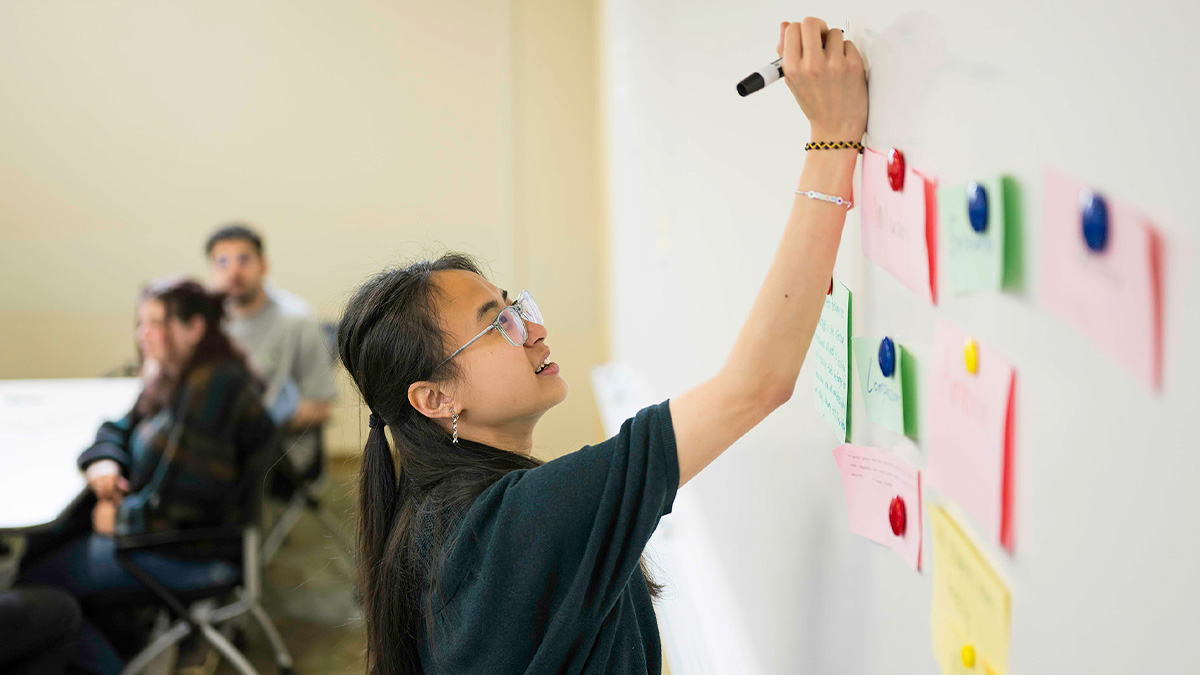
Myth: The grade is the goal.
Grades matter—especially for students pursuing competitive programs, scholarships, graduate school, or professional credentials. But treating the highest possible grade as the sole measure of success can narrow a student’s choices and make it harder to take productive academic risks.
Sia has seen that friction with premedical students. “You can’t tell them that grades don’t matter, because they do,” she says. Yet grade pressure can also inhibit exploration and a willingness to challenge oneself. Sia invites Rochester Early Medical Scholars who are now in medical school to talk with current students about “why it’s valuable to learn the thing and not just get the A.”
Martin Lynch, an associate professor of counseling and human development at the Warner School, frames that challenge through self-determination theory. The theory emphasizes three basic psychological needs: autonomy, competence, and relatedness.
For students, autonomy can mean connecting daily choices to a personally meaningful purpose. A required course or assignment may not feel optional, Lynch notes, but a student can still ask: What is my goal for this education, and how does this task serve it? That reframing shifts the emphasis from simply complying with requirements to choosing actions in service of one’s own values and aspirations.
Competence does not mean avoiding failure. It means taking on challenges that stretch current abilities while remaining attainable. Lynch describes this as seeking “optimal challenge,” or work that moves students beyond what is comfortable, gives them useful feedback, and lets them experience growth. A disappointing exam, a difficult draft, or a confusing lab result can then become information about what to try next, not a verdict on whether a student belongs.
“What do I want to understand or be able to do? Who can help me learn it?”
Relatedness is equally important. Students build it through mutually supportive connections with classmates, instructors, teaching assistants, friends, family, and, when needed, counselors. Academic pressure can make relationships feel expendable, especially during a packed semester, but Lynch cautions against treating connection as something that can be postponed indefinitely. Supportive relationships help students persist through challenge and make both autonomy and competence more sustainable.
Fletcher Roberts sees a practical version of that lesson in advising. Some students are so focused on the “highest possible GPA,” she says, that it can be difficult to encourage them to stretch. The Rochester Curriculum also gives students considerable autonomy, with room to explore interests beyond their major and cluster requirements. Options such as satisfactory/fail courses may also give some students space to investigate an unfamiliar field without tying every choice to a GPA calculation.
Try this: When you plan a semester or face a difficult assignment, pair the grade question—“What do I need to earn?”—with two others: “What do I want to understand or be able to do?” and “Who can help me learn it?” Choose at least one course, project, or activity that is challenging enough to develop a new skill, not just likely to produce the easiest result.

Myth: Struggling means you are not a good student.
A setback can feel like proof that someone else is naturally better prepared. But productive struggle is part of learning, and a student’s starting point is not always visible.
Boeck’s research has found that first-year students have rigid expectations of themselves, whereas students further into their college career recognize that struggle is part of learning, and that not everyone can meet every expectation at all times.
Sia sees the value of growth in the students she chooses as teaching assistants. She does not simply select the highest achievers. Instead, she looks for students who have improved notably over time, in part because students who found the material easy may not have needed to learn how to explain their own process of gaining mastery.
“Effort without results suggests to me that the student really needs to think about the way they’re engaging.”
Her classroom practices make room for not knowing. She offers “stump-the-professor” points that encourage students to ask on-topic questions she might not be able to answer immediately. The point is not to catch an instructor unprepared. Rather, it’s to model a response to uncertainty: “I don’t know, but here’s what I think, and let’s see if I’m right.”
That is also how students should approach their own difficulties. “I value effort,” Sia says. “But effort without results suggests to me that the student really needs to think about the way they’re engaging.” Persistence matters, but so does adjusting the approach: seeking feedback, changing a study method, visiting office hours, working with peers, or using tutoring and coaching.
Fletcher Roberts encourages students to stop using classmates’ backgrounds as a yardstick for their own progress. “Everybody’s journey is different,” she says. The useful question is not whether you’re keeping up with an imagined ideal student. It’s what the next concrete step will help you move forward.
Try this: After a setback, replace “I’m not good at this” with a brief review: What specifically did not work? What feedback can I get? What resource or person can help? What is one adjustment I will make before the next attempt? This turns struggle into a plan.
Toward a better definition
Success, these educators suggest, is less a set of traits than a way of approaching learning: with curiosity, a willingness to ask for help, and the confidence to keep adjusting when something doesn’t work.
The upshot? “Being a good student is a work in progress,” Boeck says. “You’re the only one who knows where you’ve been, and the only one who gets to decide where you’re going.”